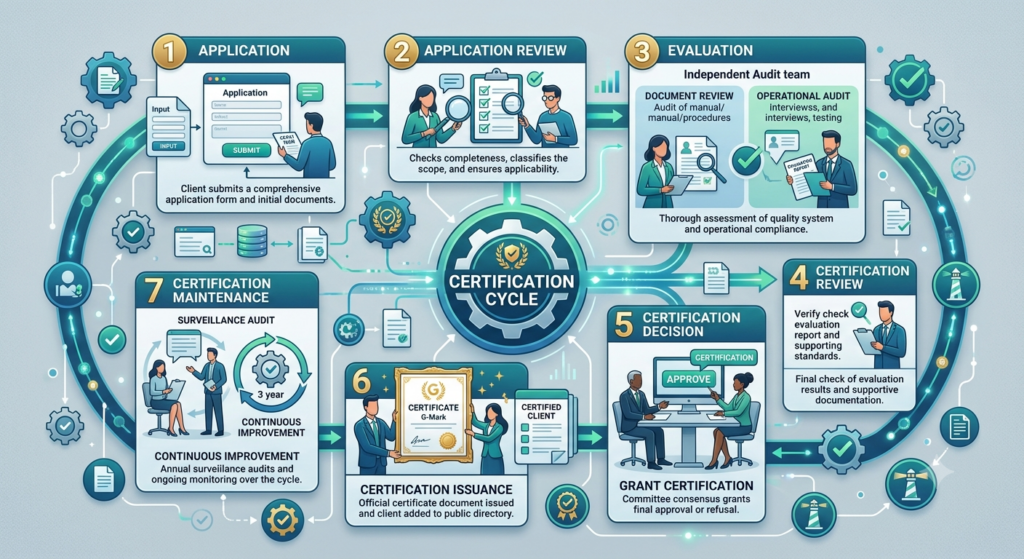
Application, application review, evaluation, certification review, decision, issuance, and maintenance.
Application Form, Product Details, Technical Documents, Test Reports and Factory Information.
Review the application documents
Learn more →Control evaluation activities to ensure that products comply with applicable standards, technical regulations, and certification scheme requirements, in accordance with ISO/IEC 17065:2012.
Learn more →Conducting an independent technical review of all evaluation results to confirm that certification requirements have been fulfilled before submission for certification decision.
Learn more →Make the final decision for certification
Issuing the certificate.
Maintain the certificate
Evaluation activities are conducted to verify compliance with applicable requirements. These may include document review, on-site inspection, testing, or other assessment methods depending on the certification scheme in accordance with procedure No. UTIC/P/ 7.4 & UTIC/P/ 7.5.
UTIC is granted only when all applicable requirements have been fulfilled and the evaluation results demonstrate full compliance with the certification criteria.
Certified products are subject to periodic surveillance (if applicable) to ensure continued compliance with requirements.
The certification scope may be extended or reduced based on changes in the product, processes, or client request, following a formal review and evaluation process.
Certification may be suspended in cases of non-compliance, misuse of certification, or failure to meet applicable requirements.
Certification may be withdrawn if the client fails to resolve issues during suspension or in cases of serious non-compliance.
Certification may be refused if the product or applicant does not meet the required criteria during evaluation or if requirements are not fulfilled.
Share the service, product, system, equipment, site, or technical context.
UTIC reviews scope, complexity, technical requirements, sites, and resources.
The correct service route is defined based on the actual request.
A clear quotation is provided before the start of any activity.
Each service route is shaped by the actual scope, complexity, sites, resources, and technical requirements.
Inspection, testing, certification, training, calibration, or proficiency testing.
The nature and complexity of the work shape the service path.
Number of sites and required resources are considered.
Applicable technical and standards requirements guide the final route.
Use related pages to understand the broader service, trust, and request path.
Share your service type, scope, complexity, sites, technical requirements, and required resources so UTIC can review the request and provide a clear quotation.